Call for speakers – UR SPIE Summer Colloquium

Do you do research involving light?  Do you get excited about it?  Do you stay up at night thinking about your research?  Do you want to tell others about your research?  Do you wish I’d stop asking you questions?  If you answered yes to any of those questions, then keep reading.
On Thursdays from Noon-1pm, during the months of June, July, and August, UR SPIE will be hosting a weekly Summer Colloquium during which 1-2 students can present their research to a group of their peers.  But, in order for this to happen, we need commitments from speakers.
The format of this summer’s talks will be as follows:
  1. Alternating weeks of one long talk (~30-45 min) and two short talks (~20 min)
  2. You can talk about research you have completed, research you are currently working on, or research you plan to do in the future.  We do not want to limit these talks to only mature research.  If you have a problem and would like to an audience to talk about it to, this can be your forum.
What’s in it for you, as speakers?  Well, I’m glad you asked.  Not only will it give you valuable experience giving a presentation in front of an audience, but you will be handsomely rewarded with the insights and suggestions from a room full of bright young minds (and maybe a few old minds, too).  And if that isn’t enough, $50 prizes will be awarded to our top two speakers, with the two runner-ups receiving an SPIE field guide.
If that all sounds pretty darn good, reply to urspie@gmail.com with a few things:
  1. Your preferred dates to give your talk (between June 20 - August 15)
  2. The topic you will be talking about (preferably a title)
  3. Whether it will be a long talk or a short talk
We look forward to hearing from you!
weneedyou
Posted in Announcements, Summer Student Colloquium Series | Leave a comment

URSPIE trip to TOPTICA!

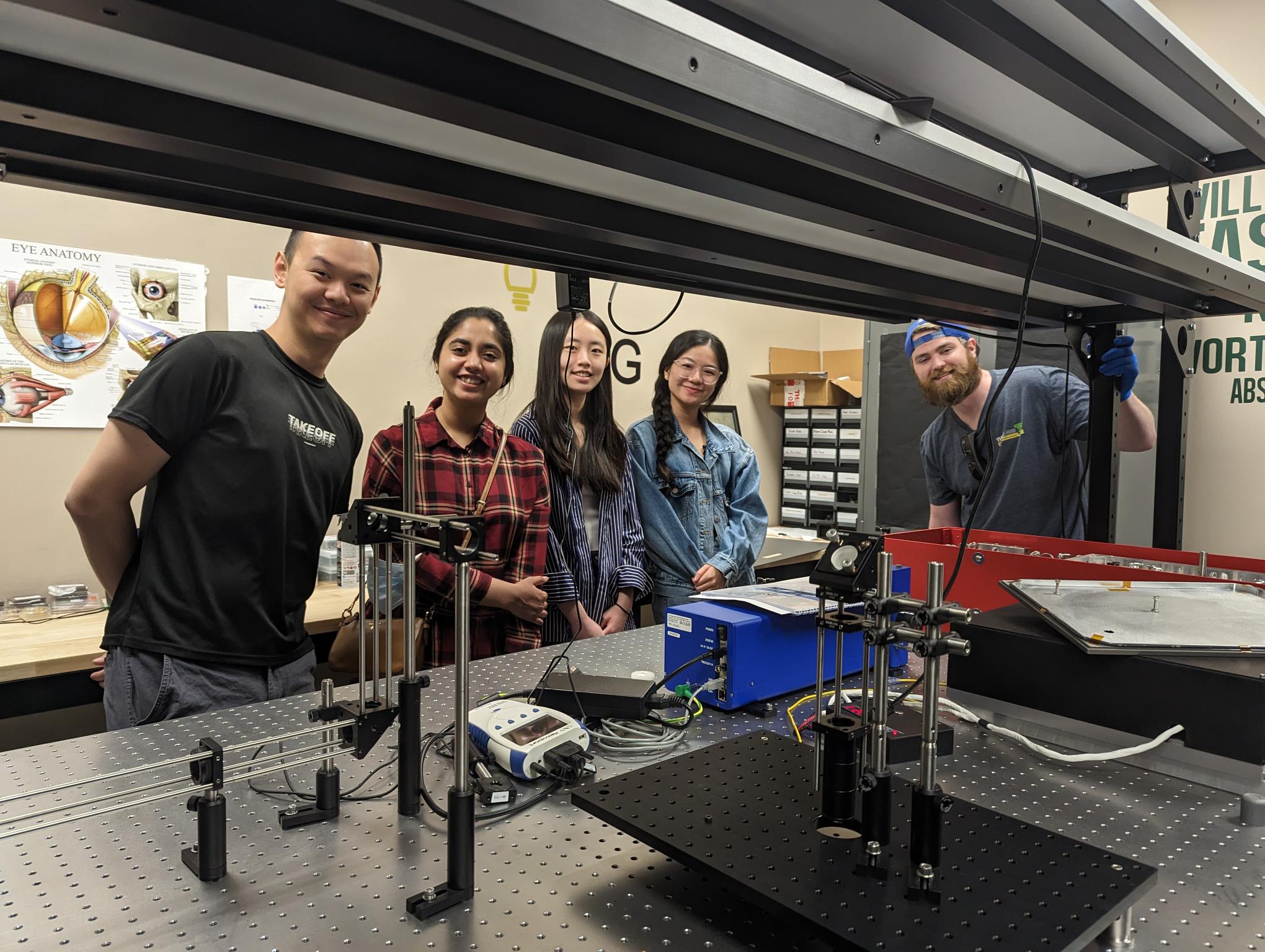
UR SPIE chapter is going to visit TOPTICA on Thursday, Oct 18th! Come and join us to visit their facility and get connections in industry! Toptica is a company located in Victor, NY, providing high-end tunable diode lasers and ultrafast fiber lasers to the industrial, scientific and homeland security markets.
Lunch will be provided. The trip will take place in the late morning and early afternoon. Details will be coming soon.The trip will be limited to 20 people, based on first come first serve. However, SPIE student members will be given higher priority.
Now you can send us an email (urspie@gmail.com) to reserve a spot for this trip. When you send an email, please indicate that if you can volunteer to drive or if you need a ride. If you are not member, you are welcome to go to SPIE website or send us an email to register.

Posted in Uncategorized | Leave a comment

Special Guest Lecturer on Oct 19th!!

Abstract:

Rachel will talk you through the concept of scientific detailed information and guidelines on scientific manuscript preparation and submission, as well as an overview of editorial process and the peer-review system. You will learn what editors seek, how to write a good cover letter and a good scientific paper, how to review a manuscript and how to make an appeal.

Biography

Working as an editor of Nature Photonics Rachel’s main responsibility is to ensure that the journal publishes top-quality research in all areas of photonics. She assesses and selects high-quality work for peer review, and makes decisions on publications. She also plays an important role in shaping the journal’s content by giving ideas on Focus issues, reviews, commentaries and Technology Focus issues. She commissions and edits news articles, and writes research highlights, interviews, editorials and press releases. Attending conferences and visiting research institutions worldwide are also essential in her role to keep her up-to-date with the latest photonics research progress and strengthen links with the scientific community.

Before joining Nature Photonics, Rachel worked for Aston University’s Business Partnership Unit in Birmingham, UK, as a research commercialization officer commercializing research output of the university, particularly that of photonics research. She obtained her PhD in microwave photonics and nonlinear optics as a member of Aston’s Photonics Research Group. Prior to that, she worked for Philips Optical Storage in Singapore as an Optics Engineer. She holds a Master’s degree from Nanyang Technological University of Singapore doing research in optical fiber sensing and a Bachelor’s degree from the National University of Malaysia.

Lunch with Dr. Won

Before the talk, you are welcome to join a brown bag lunch at 12:00 noon in room Georgen 108 with the Women in Engineering group, and meet the speaker. We will be talking about work/life balance and career path, with a question and answer session. All faculty and students are welcome.

For more information, please contact us by urspie@gmail.com.

Posted in Uncategorized | Leave a comment

SPIE General Interest Meeting!

Hey SPIE’ers! Dont forget, tomorrow (Friday September 28) at noon in Georgen 108 is the first general interest meeting of the school year! Come out and see what SPIE can do for you, and how you can help us continually be involved in the local academic community! We will be discussing several future events as well as reviewing our coloquium series, outreach, and updating you on out upcoming visiting guest speakers!


Hope to see you there!

Posted in Announcements | Leave a comment

Corning Trip

Hey SPIE’ers if you didn’t make the CORNING trip, attached are some photos. Enjoy!

Posted in Uncategorized | Leave a comment

SPIE Members Picnic

The UofR Student Chapter of SPIE is having a picnic for all of its members!  Come enjoy lunch on us!


Date: Friday, December 2nd
Time: 12:15-1:45 pm
Place: Goergen 108


OTHER FREE STUFF!  We will be raffling off a variety of prizes: SPIE Field Guides, Laser Pint Glasses, a year’s worth of membership, and more!  All you need to do is be there and be a member of SPIE!
Posted in Announcements, Uncategorized | Leave a comment

Special UR SPIE Guest Speaker and Luncheon – Michelle de Castro, Friday October 14th

Title: Optical Glass, Properties and Inspections: an overview of what optical glass is, the properties that best define glass for use in optical systems, and how those properties are measured.

Date: Friday, October 14, 2011
Time: 12pm-1pm

Place: Goergen 101

Speaker: Michelle de Castro. She is a Sales Manager and former Applications Engineer at SCHOTT North America Advanced Optics Division with eight years of technical, sales, and market development experience, specializing in specialty glasses for emerging markets related to display, touch panel, electronics, and biotech in a global sales and production environment. She is currently responsible for UV filters, thin glass and anti-reflective glass. She graduated Highest Distinction from the University of Rochester in 2001 with a BS in Optics followed by an MS in Glass Science at Alfred University. Michelle returned to the UofR in 2003 to graduate Magna Cum Laude with a BA in Japanese Studies.

Luncheon: We are going to have a members-only luncheon with Michelle deCastro from 11-12pm at Goergen 417, based on first-come-first-serve basis. The registration for the luncheon will be open on Monday (Oct 10th) noon. Please send your reservation to urspie@gmail.com. If you are not SPIE member yet, it is good time to join us now!


Posted in Announcements | Leave a comment

SPIE Summer Colloquium Series: Tuesday, August 30th

Himanshu Shekhar
Electrical and Computer Engineering

Assessment of Cardiovascular Risk with Nonlinear Intravascular Ultrasound Imaging

Tuesday, August 30
12:00- 1:00 PM
Goergen 101

Coronary Artery Disease (CAD) is a leading cause of death in America. It is characterized by the deposition of plaque on the walls of the coronary arteries of the heart. Heart attacks occur when high-risk plaques rupture in the advanced stages of CAD, causing clots that block the oxygen supply to the heart, often resulting in death.

Currently, a significant issue facing cardiologists is that of reliably identifying rupture prone plaque. If plaque vulnerability can be objectively assessed, aggressive drug therapy/ interventional methods can be employed to save those most at risk. However, X-ray angiography, the current clinical imaging technique for coronary imaging, is limited in its ability to assess plaque vulnerability.

My presentation will provide an overview of our efforts towards developing a diagnostic imaging technique to reliably predict the rupture proneness of coronary plaque.

We are adapting Intravascular Ultrasound (IVUS), for the assessment of the functional features of CAD by exploiting the nonlinear acoustic behavior of Ultrasound Contrast Agents. Intravascular Ultrasound uses high frequency ultrasound to generate cross sectional images of the anatomy of the coronary artery with a catheterized transducer. Ultrasound Contrast Agents are stabilized micrometer sized bubbles, which enable the imaging of plaque vulnerability markers, such as neovascularity and perfusion. Nonlinear acoustic backscatter from ultrasound contrast agents enables higher imaging specificity.

My presentation would discuss the advantages associated with nonlinear imaging modes, the dynamics of ultrasound contrast agents and

Posted in Summer Student Colloquium Series | Leave a comment

SPIE Summer Colloquium Series: Tuesday, August 23rd

Dr. Robert Saunders
Program Officer
Roundtable on Value and Science-Driven Health Care
Institute of Medicine of the National Academics

An Overview of Science Policy Careers

Tuesday, August 23
12:15- 2:00 PM
Goergen 108

The term science policy encompasses two disparate concepts: one is considering the policies for the scientific enterprise (such as research funding or stem cell research guidelines), while the second is applying scientific knowledge to pressing public policy questions (such as energy policy or security). While science plays a role in deciding these policies, other factors come into
play as well, including political considerations, economic factors, and values. Given this complexity, what role can scientists play? In addition to considering the role of science in science policy, this talk will also explore career paths in science policy and how students can enter this arena.

Posted in Summer Student Colloquium Series | Leave a comment

SPIE Summer Colloquium Series: Tuesday, August 16th

Yuzhe Xiao
The Institute of Optics

Adiabatic Wavelength Conversion in Travelling-wave and Resonant Photonic Structures

Tuesday, August 16
12:00- 1:00 PM
Goergen 101

All-optical signal processing, especially wavelength conversion plays a crucial role in modern lightwave systems. Many ways of wavelength conversion use nonlinear effects that require high power and phase matching. Recently, it was found that the spectrum of light can change inside a linear medium whose refractive index changes with time. The term adiabatic wavelength conversion (AWC) is used to describe this optical phenomenon. Methods such finite-difference time-domain (FDTD) simulations and a modal approach, have been used to study this effect. In this talk, we present a new approach for understanding AWC by developing a linear system model for the dynamic photonic structures. The model is first applied to a travelling-wave device to reveal a new physical picture of AWC: a rescaling of transit time by dynamic refractive index changes of the medium. We show that temporal changes in the refractive index not only shift the pulse spectrum but also lead to pulse compression and spectral broadening as well as to phase changes. In the optical resonators, our approach correctly predicts the spectral shift related to AWC. More importantly, it allows us to study the temporal and spectral evolution of an optical pulse that has been ignored so far. Our method is applicable to a broad range of integrated photonic structures, including silicon micro-rings and photonic crystal resonators, and is useful for applications ranging from all-optical signal processing to routing, as well as optical buffering.

Posted in Summer Student Colloquium Series | Leave a comment